Review brand inputs, languages, governance requirements and current content bottlenecks.
Solutions
Solutions for multilingual content teams that need scale, control and local relevance
LocaleMuse is designed for the real operating model behind enterprise content: global campaigns, brand governance, localization review, approved knowledge retrieval and human oversight. Rather than offering generic text generation, we help teams implement a managed content workspace aligned to real brand standards and market workflows.
Managed delivery
Brand-grounded AI
Human-governed workflows

A real-world multilingual rollout depends on coordinated central and local teams, shared source material and visible review ownership.
Primary use case
Global campaign adaptation
Marketing teams often have the creative direction, but not the operating layer needed to turn one approved campaign into consistent market variants. LocaleMuse supports the full path from HQ brief to localized output.
- Connect brand voice, approved claims, terminology and campaign assets before drafting begins.
- Generate first drafts for target markets while preserving message hierarchy and product language.
- Route market variants to local reviewers with clear review status and role-based access.
- Keep reusable content, references and approved learnings available for the next campaign cycle.
Where this fits best
Best suited to European or cross-border teams running repeated campaign launches, regional product marketing, demand generation programs, partner content, or multilingual nurture content where consistency matters as much as speed.
How the operating model works
From approved sources to publishable content
The value of generative AI in enterprise content is not only the model. It comes from how knowledge, governance, review and publishing are connected around that model.

The workflow is implemented through shared source material, clear responsibilities and repeatable review stages. The steps below describe the operating model.
Connect approved guidelines, product facts, claims libraries and localization references.
Create drafts for target use cases such as campaign copy, web content or product messaging.
Apply local review, legal review or editorial review with accountability and status visibility.
Capture approved outputs and reusable patterns to improve consistency over time.
Solution areas
What customers typically implement first
Brand-grounded content assistant
Turn brand guidelines, product information and approved message architecture into a practical drafting environment that contributors can actually use.
- Brand voice prompts and terminology rules
- Knowledge retrieval from approved sources
- Reusable templates for common content tasks
Localization review operations
Structure the handoff from central teams to local teams so that every market sees the same context, the same source references and clear review status.
- Localized review lanes by market
- Role-based review and approval
- Issue capture and feedback loops
Model orchestration with guardrails
Select the right approved model or provider for each task without making end users think about provider complexity.
- Task- and language-based model choice
- Governance rules and provider approval logic
- Routing based on quality, latency and cost
Pilot target scorecard
Teams often start with measurable workflow outcomes
Most initial projects are framed as a pilot. Instead of promising generic AI productivity, we usually evaluate pilot performance against the operating goals the customer already understands: turnaround time, content throughput, brand compliance, review effort and content reuse.
- Define the baseline before the pilot starts.
- Measure content quality and governance, not only volume.
- Separate implementation effort from recurring operating gains.
- Document where human review remains essential.
The scorecard presents standard pilot targets used to structure discovery and acceptance criteria. Final targets are agreed with each customer and documented in the SOW.
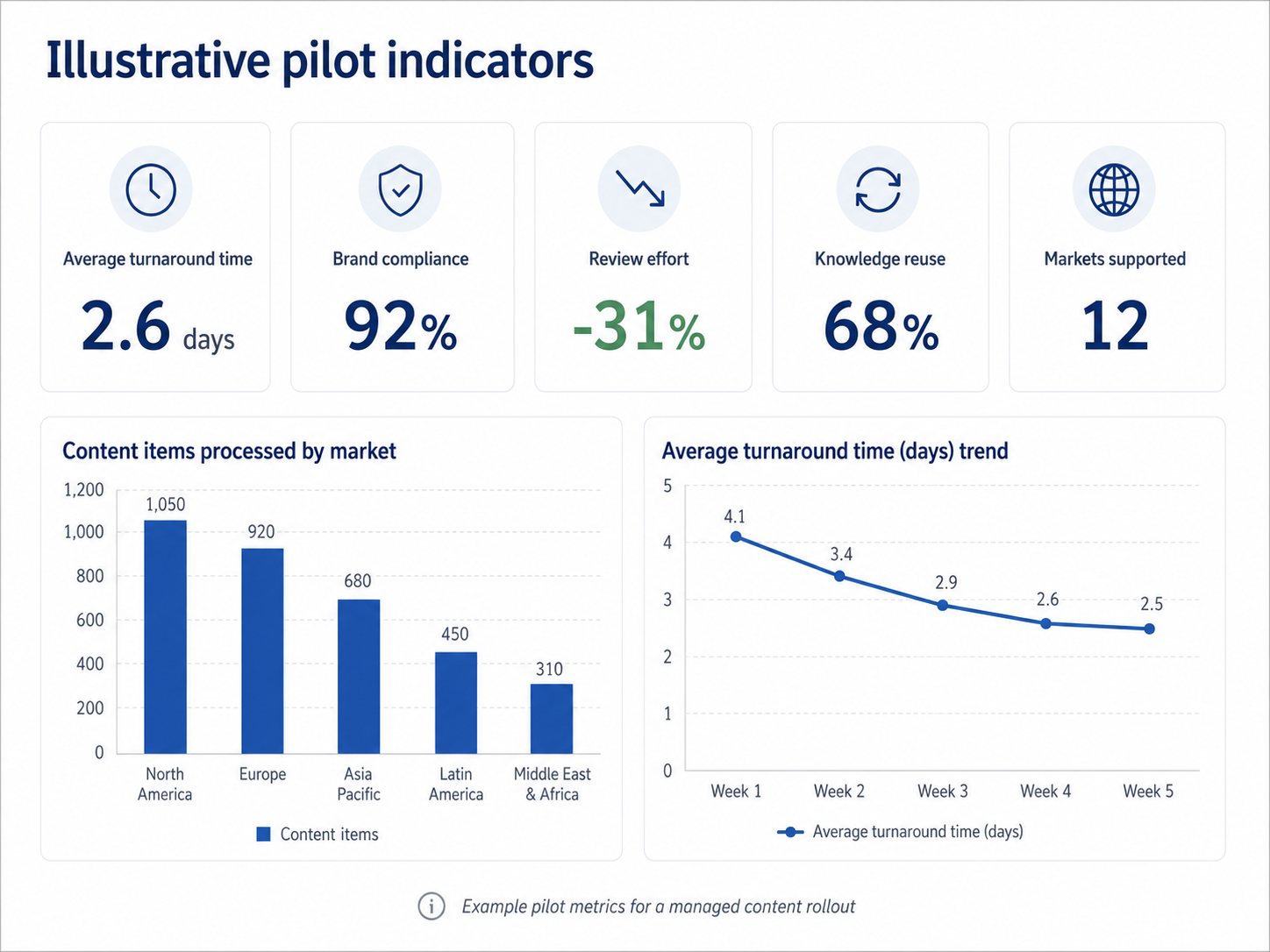
Pilot target dashboard showing how content operations improvements are measured during a rollout.
Delivery fit
Who LocaleMuse is designed for
Best fit customer profile
Cross-border brands, content operations teams, regional marketing organizations, in-house localization leaders and agencies managing recurring multilingual programs.
Common starting scope
One to three content workflows, two to five priority languages, approved brand assets, pilot measurement criteria and a customer administrator-led operating model.
Need help identifying the right first use case?
We can start with a consultation and a practical assessment of your content workflow, governance requirements and rollout priorities.