Choose one workflow, not the whole company
Pilots work best when they focus on a specific content motion that already matters to the business. Examples include campaign adaptation, product page updates, regional nurture emails or knowledge-grounded drafting for content teams. A good pilot should have repeated demand, a known review path and enough volume to measure improvement.
Define the baseline before the first prompt
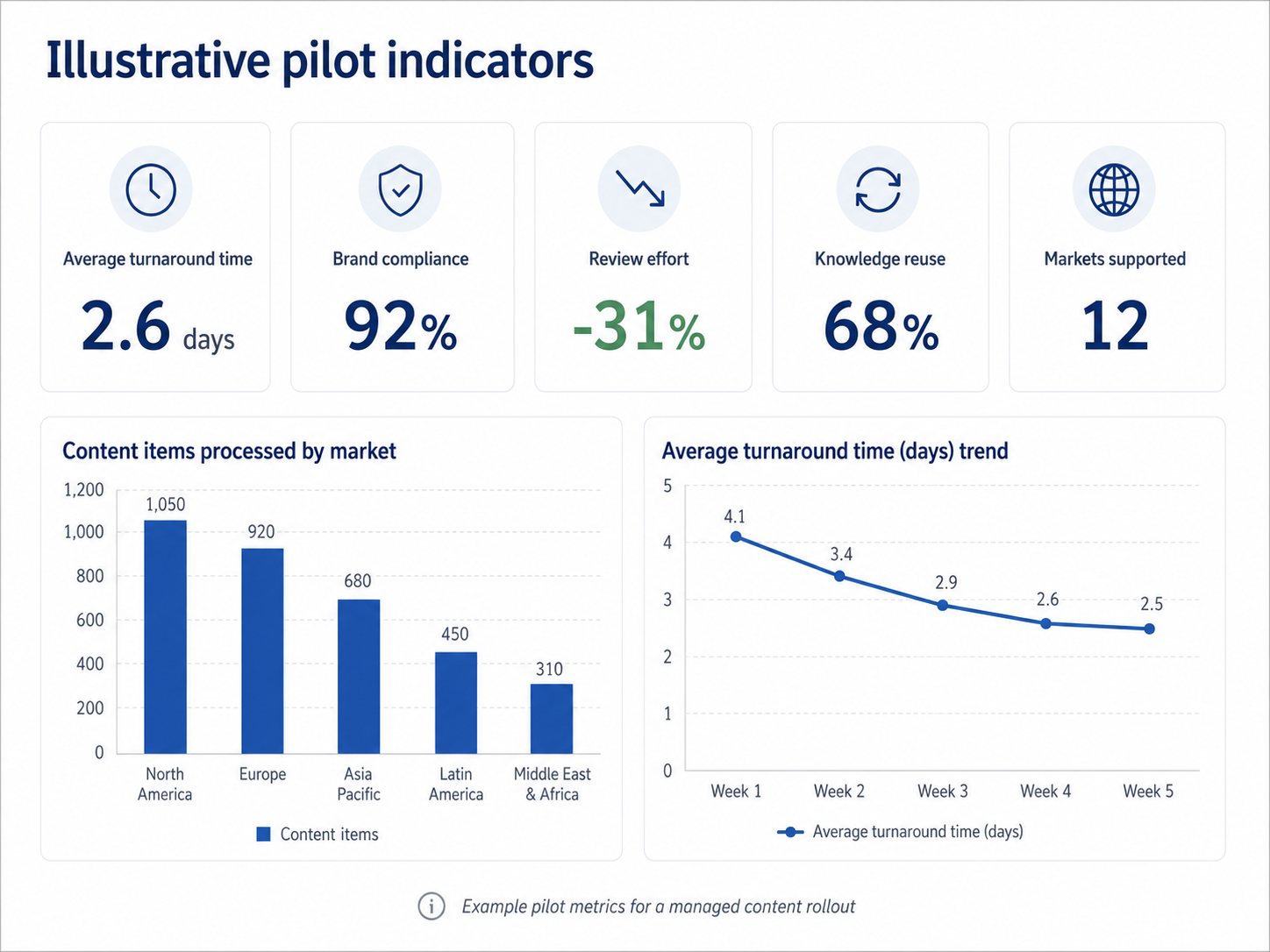
Without a baseline, “improvement” becomes opinion. Establish how the current workflow performs today: average turnaround time, number of revision rounds, common quality issues, and where local teams lose time. This makes it easier to judge whether the pilot truly changed the operating reality.
| Metric | What to capture |
|---|---|
| Turnaround time | Time from approved brief to review-ready or publish-ready output. |
| Review effort | How many rounds, edits or stakeholders are required before approval. |
| Compliance / quality | A rubric for tone, terminology, claim accuracy and local fit. |
| Reuse | How often teams can reuse approved blocks, references or prompts. |
Limit the pilot scope on purpose
Many teams try to prove too much at once. It is usually better to start with two to five target languages, a manageable set of content types and a small group of reviewers. If the workflow is successful, expansion becomes easier and better informed.
Use a scorecard that leadership can understand
Leadership teams typically care about speed, quality, governance and the practicality of adoption. They do not need an abstract AI benchmark; they need evidence that a workflow will operate more reliably. A balanced pilot scorecard helps connect operational metrics to decision-making.
End with a rollout decision, not just a demo
At the end of a pilot, the team should be able to answer: what worked, what governance is required, which content types are suitable, what still needs human review, and whether the workflow merits a larger rollout. That is far more useful than simply proving that a model can generate text.